Effortless Learning for Beginners: How to Translate Video to English
In today’s globally connected world—whether for business, academic study, or entertainment—the need to translate video to English has become a high-frequency demand. 💥However, this is far more than simple text conversion; it requires professional consideration of auditory elements, context, and culture. Not sure how to get started? 🎊This article provides the answers to help you easily overcome language barriers!


Effortless Learning for Beginners: How to Translate Video to English
While visuals are intuitive, language remains the bridge for deep communication. To make high-quality videos truly go international, bridging the information gap is crucial. Learning how to translate video to English not only lowers the comprehension threshold and expands your audience but also enhances the value of your content. So, how do you achieve this❔ We will explore this from multiple angles to help you eliminate communication boundaries and achieve smooth cross-cultural exchange!
📢Core Concepts of Video Translation
🔎Understand the Essence
Video translation is not merely converting text. Its core lies in cross-language information exchange, requiring the conversion of speech and subtitles into English while maintaining audio naturalness and visual harmony. The goal is to ensure English-speaking audiences clearly understand the main idea and enjoy a viewing experience similar to that of the original audience.
🔎Key Requirements
◽ Accuracy: As the foundation, strictly adhere to the original meaning without arbitrarily adding or removing content.
◽ Fluency: Expressions must be natural and smooth, conforming to English linguistic habits and logic.
◽ Synchronization: The translation must match the visual rhythm and audio speed to avoid timing issues or expressions that feel disjointed from the scene.
🔔Mainstream Paths for Video Translation
| 🎈Translation Type | 🎉Core Features | 📍Applicable Scenarios | ✍Notes |
| Manual Translation | Context-aware with high adaptability; handles complex content flexibly. | Academic exchanges, commercial demos, and scenarios requiring superior quality. | Time-consuming and requires a translator with professional qualifications. |
| Machine Translation | Simple process, fast completion speed, and relatively low overall cost. | Internal communication, daily sharing, and scenarios prioritizing speed. | Potential for semantic errors; complex content requires verification. |
| Hybrid (AI + Human) | Balances efficiency and quality; reduces the burden of manual work. | Social media distribution, corporate PR, and most standard video translation scenarios. | After the machine generates a draft, manual proofreading is needed to rectify errors. |
📝Recommended Method for Video Translation
✨TranslateAI
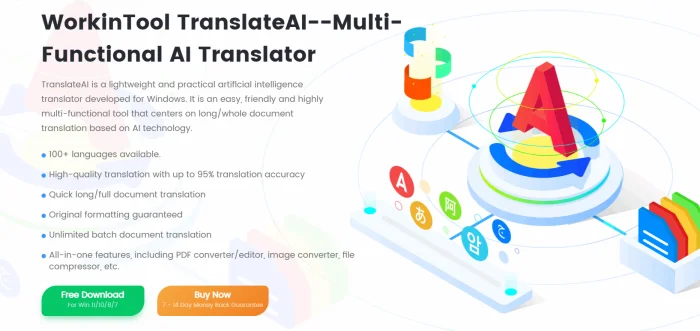
An intelligent translation software designed for Windows, supporting over 100 languages. It covers image, text, and document translation modes and is equipped with conversion, recognition, and compression tools to meet diverse needs.
🔑Step-by-Step Walkthrough
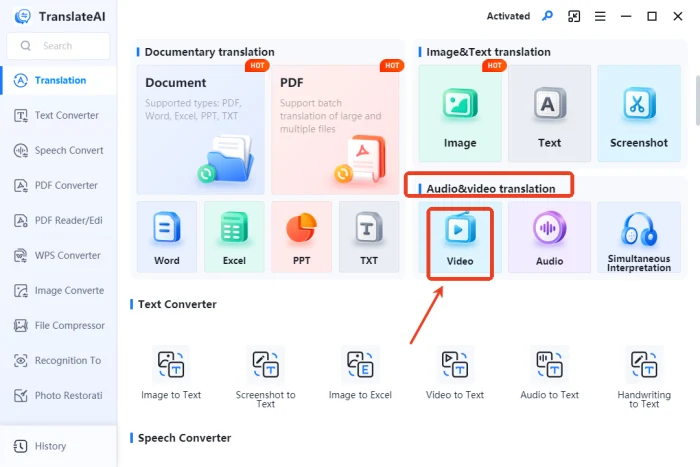
▪ 1. Launch the software, find the “Audio&video” category on the main interface, and click [Video].
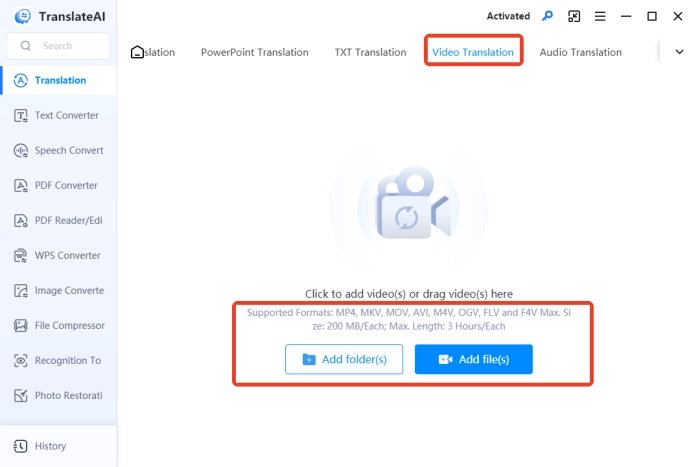
▪ 2. Add single or multiple files; supports formats like MP4, MKV, MOV (Single file limit: 200MB & 3 hours).
▪ 3. Set the source language based on the video, then select “English” as the target language.
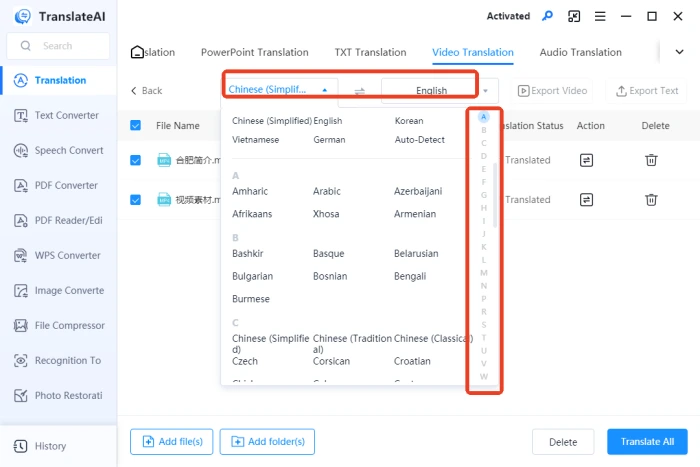
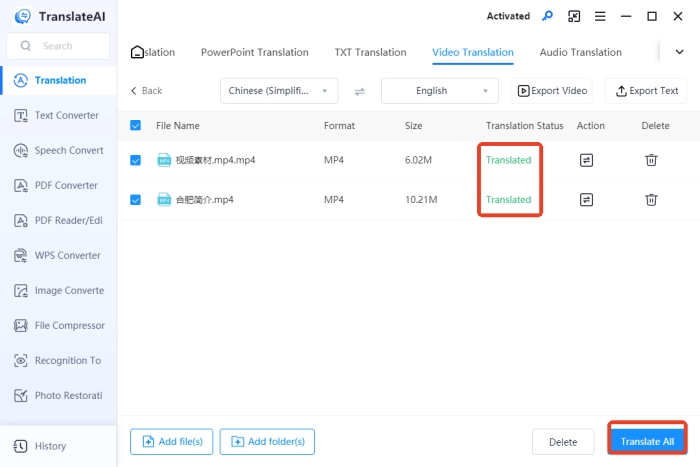
▪ 4. Click “Translate All” at the bottom right and wait for the status to show “Translated“.
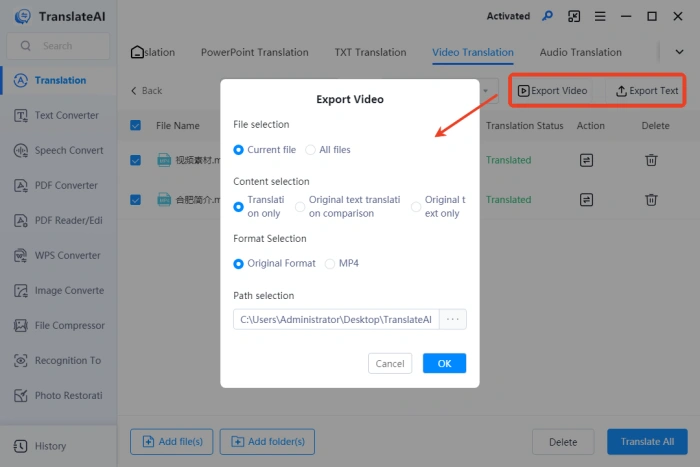
▪ 5. Choose to export as video or text; content, format, and save path can be adjusted in the settings.
🌈Practical Techniques for Video Translation
◾ Contextual Adaptation: Adjust the translation style based on the scene and emotion. Use standard written English for formal settings and natural, colloquial expressions for spoken scenarios. Avoid mechanical literal translation to ensure the text fits English habits and aids audience understanding.
◾ Rhythm Control: Control the word count per subtitle screen for readability. Break sentences according to the speech rhythm. Use playback checks to adjust subtitle timing, ensuring sync with the audio to prevent pacing issues from affecting the viewing experience.
◾ Terminology Consistency: Identify professional terminology and their English equivalents beforehand. Maintain consistency throughout the translation to avoid “inconsistent terminology,” thereby enhancing professionalism and preventing audience confusion.
◾ Cultural Mediation: When encountering culture-specific content, preserve the core meaning and replace it with expressions familiar to English audiences. Add brief background context if necessary to avoid misunderstandings caused by cultural differences.
◾ Emotional Transfer: Fully grasp the original emotion and use appropriate English syntax and vocabulary to convey joy, anger, or sorrow. This allows the English audience to accurately perceive the video’s mood, enhancing empathy and engagement.
🙋♀️Troubleshooting Common Issues
📌Q1: What if the translation doesn’t sound colloquial enough?
A1: Abandon long, bookish expressions in favor of daily conversational syntax and shorter sentences. Also, adjust the tone based on the character’s identity to fit the spoken context of the video.
📌Q2: How do I handle inaccurate translation of professional terms?
A2: Consult authoritative industry dictionaries and official terminology databases. Confirm the meaning within the video’s context to avoid literal translation. If doubts remain, consult professionals in the relevant field for verification.
📌Q3: Can idioms or internet memes in the video be understood when translated into English?
A3: Literal translation usually fails. Technically, you need to adopt a “free translation” (paraphrasing) strategy, finding equivalent slang or idioms in the English context to replace them.
📌Q4: Why do the translated subtitles sometimes lag behind or not match the audio?
A4: This is caused by “information density” differences. English expressions often contain more syllables than Chinese. If you directly apply Chinese timecodes without recalculating the in/out points, the subtitles may display briefly or appear delayed.
📌Q5: Can machines correctly translate polysemous words?
A5: This depends on “contextual correlation.” Modern models rely on attention mechanisms to analyze preceding and following sentences. Accuracy is high for long sentences, but algorithms easily misjudge isolated short words, requiring manual semantic correction.
💡Conclusion
Learning how to translate video to English begins with language conversion but ultimately relies on comprehensive skills. It requires conveying the original intent while ensuring a high-quality viewing experience. From preparation and execution to final polishing, every step deserves careful attention. 💪By mastering scientific methods, avoiding common pitfalls, and continuously accumulating experience, you can produce polished translations. 👏We hope this article serves as a useful reference to help you handle various video translation needs with confidence.

Related Article
 How to Translate a Video to English Online and on Windows
  How to Translate a Video to English | Practical Tips to Share How to Translate Excel File to English on PC | 3 Ways